
Little Monsters
"Bad" children and how (not) to write about them

(The following is a talk I contributed to a symposium on Risky Character in Crime & Writing on Crime, at Jesus College, Cambridge University on February 26, 2026)
Although I titled this presentation Little Monsters, it might more appropriately have been called Little Bastards. Or maybe that would have been a shade too salty… too risky.
My subject is commonly recalled as the James Bulger case. Unlike many notorious crimes, it is remembered primarily for the name of its victim, not its perpetrators, who were both aged ten.
I have lived with the case for more than three decades. I have since written hundreds of thousands of words on a variety of subjects, but I don’t suppose more than a day or two has ever passed when I have not thought about it.
I was there at the very grown-up Crown Court in Preston in 1993 when the Monsters in question were convicted of that small boy’s murder.
Shortly afterwards they were sentenced to be detained at Her Majesty’s Pleasure - the junior version of a life sentence. “Let them be taken down”, said the judge when he had finished. Into the moment’s silence that followed came an angry, anguished shout from the front row of the public gallery at the back of the court.
“How do you feel now, you little bastards.”
It was a member of the victim’s family, an uncle. His words in that precise phrase were co-opted for a front-page headline in the next morning’s Daily Star tabloid newspaper, date November 25th, 1993.
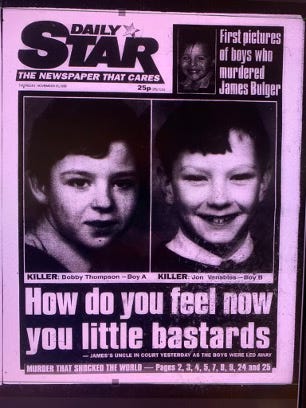
I still remember how shocking and depressing those words sounded and, soon after, looked in bold newsprint. I know – I have always known – that you cannot of course tell the relatives of a child who has been murdered what they ought to be feeling, thinking, saying or doing. I surely do not have that moral right. The family’s suffering has been beyond imagining.
But those words ringing out across the court, trumpeted in a newspaper headline - and very many others like them, expressing similar sentiments, amplified across our country, across the years, seem to embody the tone of debate that has always and still surrounds this most risky and troubling of cases and indeed all children who commit the gravest offences.
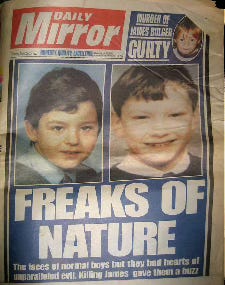
Personally, I reject a world in which it is okay to speak like that about small primary school aged children, no matter how terrible their crime. I worried about it then and I still worry about it now. I make no apology for expressing the view that, so far as I am concerned, child perpetrators can be and invariably are victims too.
I wanted to direct this brief presentation to just a few of the myriad ways in which I think it is possible to swim uphill as a reporter, to challenge assumptions, to raise questions about the way our justice system treats young people who commit serious crimes, to interrogate the reasons why those crimes occurred, to look beyond concepts of “bad’, “demonic”, “evil” and find a less demeaning language - a more compassionate tone for such public discussion.
I am aware that is a big ask, even more so now, in the age of social media. The age in which someone, bot or not, can quite casually post on Twitter/X that “hanging the c**t would be even cheaper” about one of those two boys after he was convicted of further sexual offences.
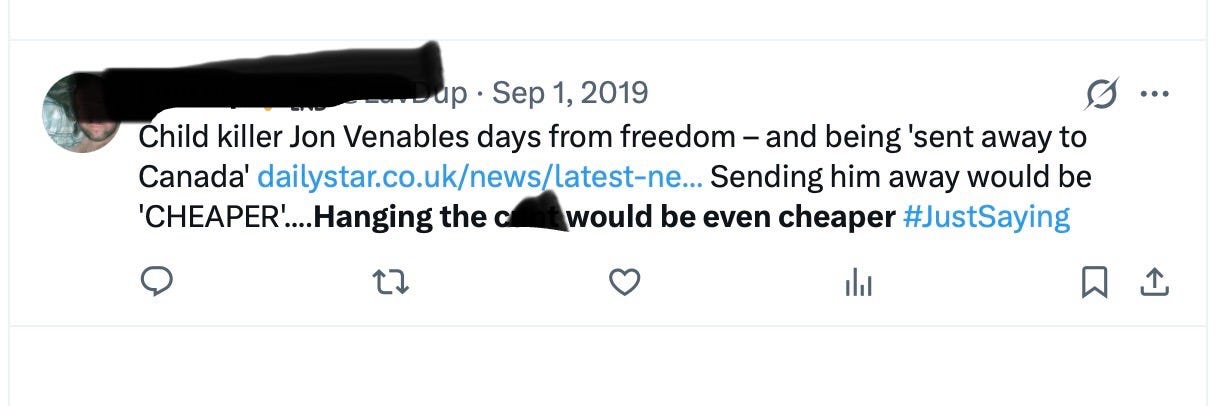
I could have produced hundreds of similar examples of the ugly attention this crime continues to attract.
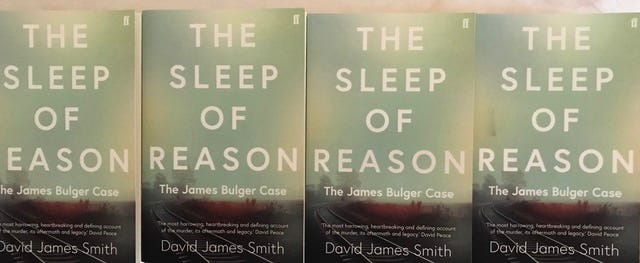
From the start, I looked upon the case as a tragedy for three families. I wrote that in the introduction to my book about the case, The Sleep Of Reason first published the year after these events occurred. I am not suggesting there is a precise equivalence in the impact across the families, but I do believe all their losses and agonies must have been immense in their own way.
That belief has shaped everything I have ever said or written about the case and will continue to do so. I have tried to promote these different ways of approaching the case, tiptoeing through an ethical minefield, making my own transgressions along the way, knocking on doors, both real and metaphorical, not always welcome, sometimes privy to information that might be considered confidential, trying to justify those actions and the use of that material by a balancing exercise, weighing the intrusion against a sincere, and by now well-practiced attempt to improve public understanding, shifting people’s attitude where it is possible - seeking to supplant vilification, condemnation and biblical expressions of wickedness with empathy and humanity. And of course – as I am always acutely aware – going, as all journalists must do, through a self-serving process of self-justification.
When people post one-star reviews of my book on Amazon. And – ouch - they sometimes do, the rating is usually tethered to remarks about how my work is ignoring the victim or excusing the boys’ behaviour.
I get it, but I think those readers are wrong. I do not seek to excuse or diminish the terrible thing the boys did.
On February 12, 1993, they did bunk off primary school and run amok in a shopping centre in north Liverpool, shoplifting and cheeking store staff and generally being pests, until they eventually lured a two year old boy from his mother and took him on a meandering journey on foot over two miles, before subjecting him to a horrific fatal assault on the railway line that passes over Walton village.
I had no motive to shy away from the reality of what had happened. In all my work I have adopted the approach that you should stare the facts in the face, not seek to dilute the impact of awful events, not to look away, to be unflinching in examining the truth, no matter how grim. In this case, I believe, that turned out to be a valuable lesson. While I know some people can’t bear to confront what the boys did to their victim, and that there is a risk of alienating readers by not self-censoring, by setting it all out in the starkest of terms, the account in my book serves as a kind of journal of record.
Even before the trial, in the vacuum of information before the precise details became known, gruesome urban myths began circulating, about what had happened up there on the railway line. In the years since, the same pattern has emerged. But I can say, here in my book is what happened. God knows it is bad enough, without the need for myth-making embellishments.
My version is close to the truth, it leaves nothing out that I know of. I always try to leave nothing out. Here is the truth, for good or ill. Take it or leave it. I imagine myself building a relationship of trust with readers. A relationship of truth, such as it is. Perhaps naively, I believe in objective truth. I go in search of it on the basis that if an event happened, it is discoverable, and if it is discoverable, it is describable, albeit filtered through the frailties of memory, perspective and bias. Nowadays, I realise, in a case such as this, that approach would probably require a trigger warning.
There was never the slightest shadow of a doubt that they had committed the act – the full majesty of the month-long trial at the Crown Court was a sledgehammer to crack a nut in that respect.
I would argue that the trial, the legal process generally, was a pretty risky enterprise in itself. You won’t hear this reported very often, but I have seen evidence it did lasting harm to at least one of the two boys, and probably both, making an ugly spectacle of the pair of them – perched up there in the dock for all the reporters to gawp at, subjecting them to a humiliating and traumatic process, being forced to relive every moment of that terrible crime in minute and repetitive detail. Sitting there listening as their police interviews were played into the court, one boy forced to hear his own desperate sobs of admission to the crime. I did kill him, he said in interview, while curled up in his mother’s lap, as she cradled him like a baby.
There was a version of justice, open justice, of course, in that trial, a transparent process and that was important. The case was so notorious and so shocking it was like a boil that needed to be lanced and that perhaps was the role of the Crown Court spectacle.
But who was thinking – who is, even now, willing to think - about the rights of the defendants:
- That they were too young to properly instruct their lawyers
- That they were denied pre trial counselling, in spite of the trauma they had already lived through, because that might have impeded the trial process, by eliciting awkward confessions.
- That they were taken from their families and locked up on remand with other, older, committed young offenders, before they had been found guilty of any crimes
- That they were transported to court in vans where a lynch mob – there really is no other phrase to describe it – overwhelmed police lines and attacked the vehicles, banging on them, baying for the blood of the children inside.
- That despite the overwhelming evidence of their guilt they could not be persuaded to let go of their childish denials and plead guilty (which would obviously have been in their best interests and everyone else’s) and had to go through the full trial process in the intimidating setting of a Crown Court, perched up in the dock, looking out on the barristers and the judge in their wigs and gowns, while their every gesture was being scrutinised.
- That they probably understood only a tiny percentage of what was being said and done during the trial. Their concentration must have been affected, not just by age but by trauma too. I know one of the boys said he used to count numbers in his head to pass the time and distract himself from what was going on.
The court procedures for school-aged murderers are a little different now. More consideration is given to the ages of child defendants. I attended the recent murder trial of two 12-year-olds in Wolverhampton where the judge and the lawyers appeared without their wigs and gowns, and the defendants were allowed to sit outside the dock, at a court bench, sandwiched between a relative and what is known as an intermediary. One of the boys gave evidence while holding a comfort toy.
“condemn a little more and understand a little less” - Prime Minister John Major
In the recently updated judicial colleague guide to “Child Defendants in the Crown Court” there are sections on “special measures” and “other measures to assist defendants” that judges may adopt, tailored to the age of the defendants, but all those measures do still sit in the context of a full blown Crown Court trial.
I know that one lawyer involved for the defence in the 1993 case has never stopped worrying over whether they did right by their client. Both boys were condemned by their own lies in police interviews. A lawyer could have advised them to go “no comment” in answer to all the police questions. But of course, no lawyer could have a mature conversation with a ten-year-old client.
If there was ever a piece of reflective reporting that stopped to consider these aspects of the case, I did not see it. That was not the mood of the moment. The Labour shadow home secretary, Tony Blair, had already famously said he wanted us to be tough on crime, tough on the causes of crime. The Conservative prime minister John Major believed it was time to “condemn a little more and understand a little less”.
You might have thought that the opposite was required, and leadership demanded he say so, but no politician wanted to be on the wrong side of this case and that national mood of hatred and vindictiveness towards “bad” children that it had created. Journalists who would challenge that dogma were thin on the ground too.
Elsewhere in Europe the case would never have come to court. In those countries – France, Germany, Italy, Scandinavia of course - children of that age are not held criminally responsible. I guess you could say they are looked upon with consideration rather than condemnation.
The age of criminal responsibility in England and Wales was set at ten years by the 1963 revision of the Children and Young Persons Act. When it was first implemented 30 years earlier, this Act had raised the minimum age to eight from seven, at which it had been fixed since the Middle Ages. Don’t get me wrong, things had improved. We had not hanged a child for murder since John Any Bird Bell in 1831
The law had also determined that a child becomes a young person on his or her fourteenth birthday. Between the ages of ten and fourteen children in 1993 were believed to be doli incapax, which literally meant incapable of doing wrong.
In practice, the law then presumed they were unable to understand the seriousness of their actions. To obtain a conviction the prosecution needed to actively rebut this presumption, proving to the court’s satisfaction that the child would have known the action to be seriously wrong, and not just mischievous or naughty.
I knew that doli incapax would feature during the trial and I innocently assumed it would be a central feature that might bring the trial to a premature end if the rebuttal could not be proved. I wondered how you could show that two boys really knew what it meant to kill someone.
After all, one of the boys had asked in police interview if they had taken the victim to hospital “to get him alive again”. I waited in vain for the big legal bout to begin. In the end it was a damp squib, the issue took up just about 23 minutes of the court’s time and no one seemed in any doubt that they knew what they were doing. I could find no one who shared my unease at this, let alone anyone who was prepared to say so. The principle of doli incapax was abolished by act of parliament in 1998. Even that limited shield for children was excised from criminal law.
In this vein the trial proceeded to its conclusion when the judge was faced with a critical decision – whether or not to name the two boys if they were convicted. As is common practice in cases involving children, the judge had imposed a reporting restriction at the start of proceedings. In 1993 the relevant provision was S39 of the same Children & Young Persons Act, first enacted in 1933 and since superseded by S45 of the Youth Justice & Criminal Evidence Act 1999, which came into force in 2015.
Case law on the issue of whether children who commit serious crimes should be named reflects a broad weighing of the public interest against the interests of the defendants and their right to rehabilitation - competing human rights as between Article 10, freedom of expression and Article 8, the right to privacy. The law only applies to children and so the restrictions expire at the age of 18. In some cases, further protection is needed, not simply to support rehabilitation but to prevent vigilante or revenge attacks, which may bring Articles 2 and 3 (the right to life and the prohibition on torture) into consideration.
These two boys – the boys in question - had been anonymised throughout the trial as Boy A and Boy B.
The judge heard the application to name them, made by a media organisation, while the jury were still deliberating, and announced his decision – to name them – immediately after the verdicts.
I must admit here that I was not a neutral observer in the debate. I wanted them named, selfishly for the sake of my book. It would have been very difficult to write about them, I felt, if you had to disguise their identities. I feel bad about that now. I have come to believe that naming them was a mistake. Good for my book but not good for the boys or their families.
In his decision the judge said that interest in the trial was (and I quote), “not merely a case of ghoulish interest in the macabre. This was a ghastly crime, and unbelievable that it could be perpetrated by one or two ten-year-old boys.”
It could be argued, he went on, that it was in the public interest that the circumstances, the exposure of children today to films, radio, television and newspapers, video and so on may have played their part. There could be a role for legitimate investigation, which would be of interest to serious sections of the public.
I could not agree more with the judge that the circumstances of the killing were a legitimate subject for investigation. I could not disagree more that the answer lay in media representations of violence. That was a total red herring – there had been no evidence to support that proposition, either in the trial itself, or in the background to the case. There was some tangential evidence one boy’s father had rented what used to be called video nasties, and the son could have seen them. The often-cited example was the film Child’s Play 3.
“I could not agree more with the judge that the circumstances of the killing were a legitimate subject for investigation. I could not disagree more that the answer lay in media representations of violence.”
Perhaps the judge had allowed his own prejudices to cloud his judgement. Quite obviously the case had its roots in adverse childhood experiences, generational family dysfunction and varieties of familial abuse. I thought that then and I still think that now. Those are the real risk factors. But who was interested in that narrative? A national newspaper editor once said to me, a lot of people come from bad backgrounds, David, they don’t all go out and kill a two year old.” That is true – such backgrounds may find their outlet in many distinct ways, perhaps in violence, but notably in varying degrees of mental health difficulties.
With hindsight, I think the disclosure of the boys’ names can be interpreted as a way of offering them up for public evisceration. There was little by way of empathetic inquiry. There never has been. That is not the media narrative that attached itself to these events. Case law now requires that children who commit grave crimes must not be “named and shamed” – which is surely what happened in 1993.
As you will realise, those two boys are now grown men. They are both 43 years old in fact. They served eight years in detention before their release in 2001. At the time of their release a judge was presented with good evidence they might be found and killed when they came out.
A relative of the victim had said openly he would hunt them down. So their birth names were consigned to history. They were given new identities and are protected by lifelong injunctions which prevents anyone revealing their new names, addresses or likenesses, or any information that might lead to them being discovered. The risk of harm was real and remains real, not least, I am sure, in the minds of the boys and their families.
Between them, the boys had 13 other immediate family members who were also obliged to seek the safety of disappearing behind new identities. There may by now be children and grandchildren of the wider families and they too may feel the shame and fear the harm of association. Thirty-three years have passed since the case occurred but time has not dimmed the public appetite for loathing and punishment.
The aftermath is now a constant presence on social media. TikTokkers post teasing claims about the real identities of the two boys, perhaps not always appreciating the risk they are taking, as they sail close to committing criminal offences of contempt by breaching the injunctions. Users posting images purporting to be of the boys, on X have been jailed in recent years.
As I mentioned earlier, one of the two boys has twice been returned to prison after committing crimes related to hoarding illegal images of child sexual abuse. I have tried to write with understanding and compassion even about this, again, I stress, not to excuse or forgive such crimes, but to contextualise them by placing the perpetrator as the product of dysfunctional family circumstances and the survivor of deeply traumatic events. It is entirely possible that the trauma of the crime itself, contributed to his more recent offending.
But we are in a populist age where people are plainly more interested in condemning than understanding, in reviling rather than humanising. It is a kind of denial that child perpetrators can be victims too.
For me, as for others, the case never goes away. There is always a documentary in the works or a news event that requires some comment. In a few weeks the middle-aged “boy” in prison will be facing a parole panel contemplating his release and the risk he poses. As I speak, I am once again immersed in a project related to the case. Once again wrestling with the ethical issues and the sensitivities that surround it.
When, in 2018, a slightly naïve but gifted Irish filmmaker made a short film Detainment which skilfully and quite movingly recreated the incident and the boys’ police interviews, he neglected to inform the family of the victim and they were very upset. They let it be known how they felt. When his film was nominated for that year’s short film Oscar, he became the target of widespread abuse and actually had to go into hiding after receiving death threats.
In that world, for the reporter who dares to challenge the orthodoxy, or the public mood, there is only risk.
Risk and one-star reviews.
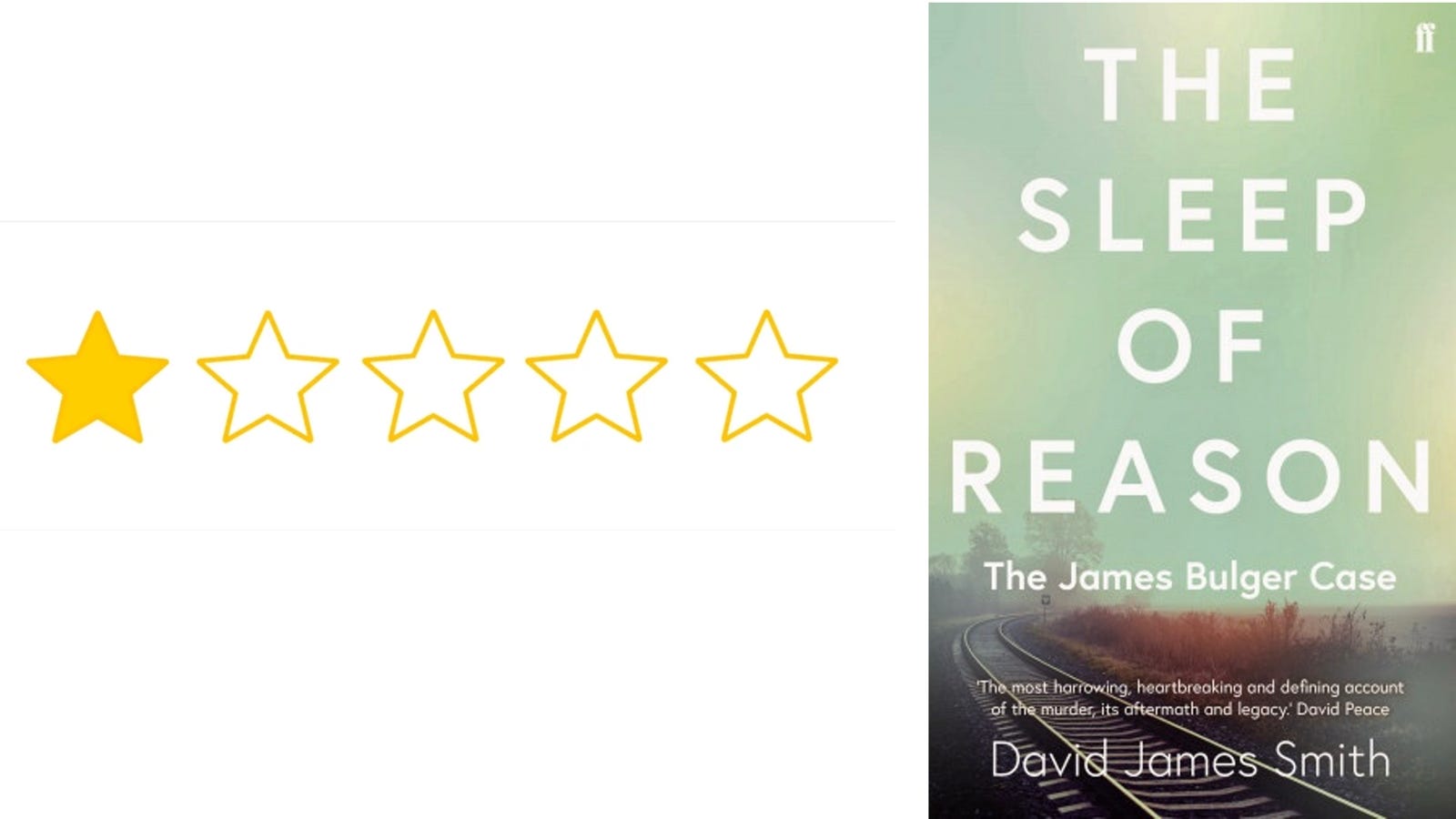
Available here: The Sleep of Reason - The James Bulger Case
Thank you for reading notes on crime. Subscribe for free to receive new posts and support my work.
Like you, I always had very grave misgivings about the way the two boys were dealt with in the case. I had, and still have, no understanding of how they could commit the acts they did (I can't understand how adults do, either), but it was clear that a cycle of abuse was being initiated by the courts and media. It also disturbed me how many adults would see (or do) the killing of these 10-year-olds with pleasure. Blair's grubby fingerprints all over it just make it worse.
Great piece, thank you. And thank you for choosing to write about these people with compassion.