
The Amazing Mr Beck
Part One - The Moment His Life Changed

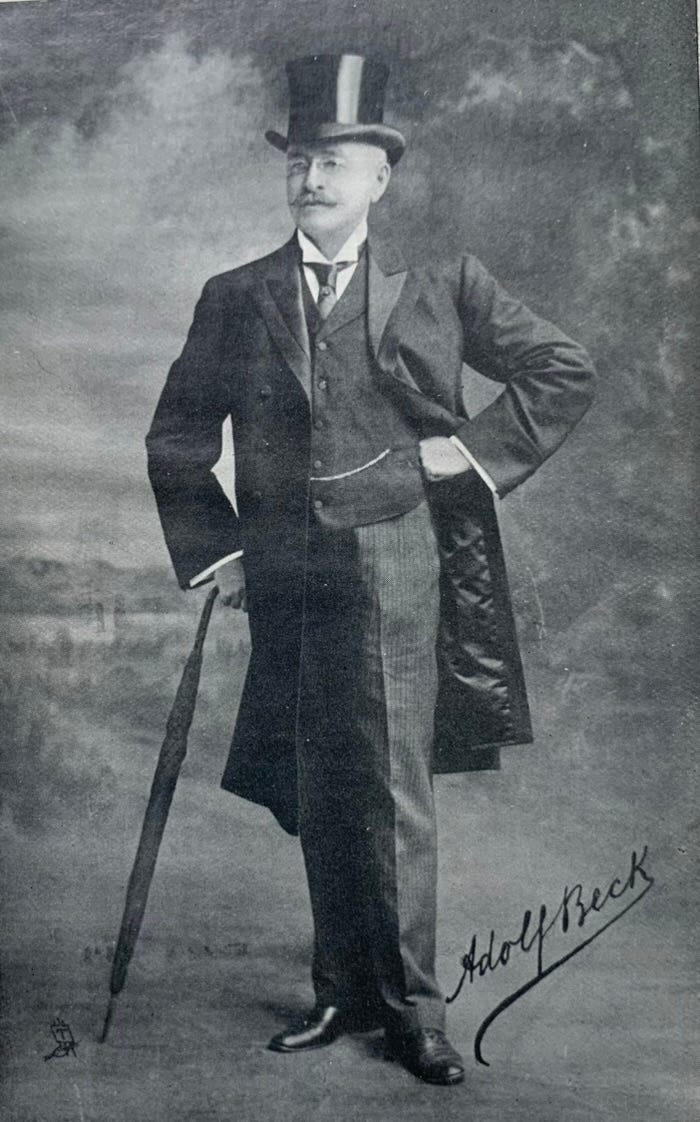
After his adventures in South America, during which he had tried and failed to make his fortune in stocks, shares and concessions, while dabbling a little in the arts, accompanying a pianist as a singer in Montevideo and trying to form a theatre company in Bolivia, Mr Adolf Beck returned to London, still pursuing success in the late golden age of enterprise.
Norwegian born, and by now in his early 50s, Mr Beck lived for a few years at the Covent Garden Hotel, where he built up a sizeable personal debt to the proprietor, who indulged his guest for a long time on the basis that he “always dressed very nicely and behaved gentlemanly and never brought any persons into the house.”
A gentleman, he may have been, with his pince-nez, his fob watch on a chain and his habitual high hat, but Mr Beck was unable to settle his debts, and eventually the proprietor’s patience expired. Mr Beck moved to the Buckingham Hotel nearby, in The Strand, and stayed there a few months before he took lodgings at 139 Victoria Street, the main thoroughfare between the Houses of Parliament and Victoria railway station.
On December 16, in the late afternoon, he was standing on the steps of his new home, looking out across Victoria Street, hoping to see a newspaper boy, when he was approached by a woman passing by.
Ottalie Meissonier had just been shopping in the Army & Navy Stores nearby when she caught sight of Mr Beck. She stepped up to him and touched his coat, and he returned a smile, which must soon have frozen.
“Sir, I know you” she said.
She described how he tried to push past her into the street.
“What do you want from me?”
“I want my two watches and my rings”, she said.
There in that moment, Adolf Beck’s life was cleaved in two. There was his life before and his life after, which was foreshortened and would never be the same again.
The year was 1895. The Case of Adolf Beck did not just change Beck himself - destroy him, in fact - it changed legal history and still reverberates even now.
It has echoes in the modern-day tragedy of Andrew Malkinson who served 17 years in prison for a violent rape in 2003 which he always insisted he had not committed. Mr Malkinson’s problem was that he had been positively identified as the attacker, not just by two passing witnesses, but by the victim herself. They were all wrong, a fact that took 20 years to establish beyond doubt, with the discovery that the assailant’s DNA did not belong to Andrew Malkinson.
There were questions about the integrity of the two passing witnesses in Malkinson’s case, but you may wonder, generally, how honest witnesses who are mistaken can be so certain they are right. Identification evidence is fraught with dangers which are by now well-known, yet miscarriages still occur in spite of the precautions and safeguards that have long been in place. Identity parades – often now given by video – are subject to strict rules, while jurors in cases where such evidence is significant and contested by the defence are given guidance to treat the evidence with caution: The so called “Turnbull direction” is based on a 1977 high court judgment Turnbull (1977) QB 224 which requires judges to warn juries of the risk of error by identifying witnesses, and to take all the circumstances of the identification into account.
None of that helped Andrew Malkinson and none of that was in place at the time of the accusations made against Mr Beck.
Mr Beck’s case is the origin story of misidentification leading to wrongful conviction. His experience is really in a league of its own, for a number of reasons, not least among them the resilience and determination of the accused. Mr Beck was identified as a fraudster by multiple women complainants - so many in fact that it’s hard to keep count, or make sense of how that happened.
Mr Beck was arrested, tried, convicted, imprisoned and released, only to be arrested, imprisoned, tried and convicted again. He campaigned for his innocence without pause, and actively attempted to investigate his own case, never knowing that the evidence that could have exonerated him was sitting in the Home Office files all along.
Finally, he became famous - a cause celebre in Edwardian London, subject to standing ovations wherever he appeared. He really was, the amazing Mr Beck. This is his story.
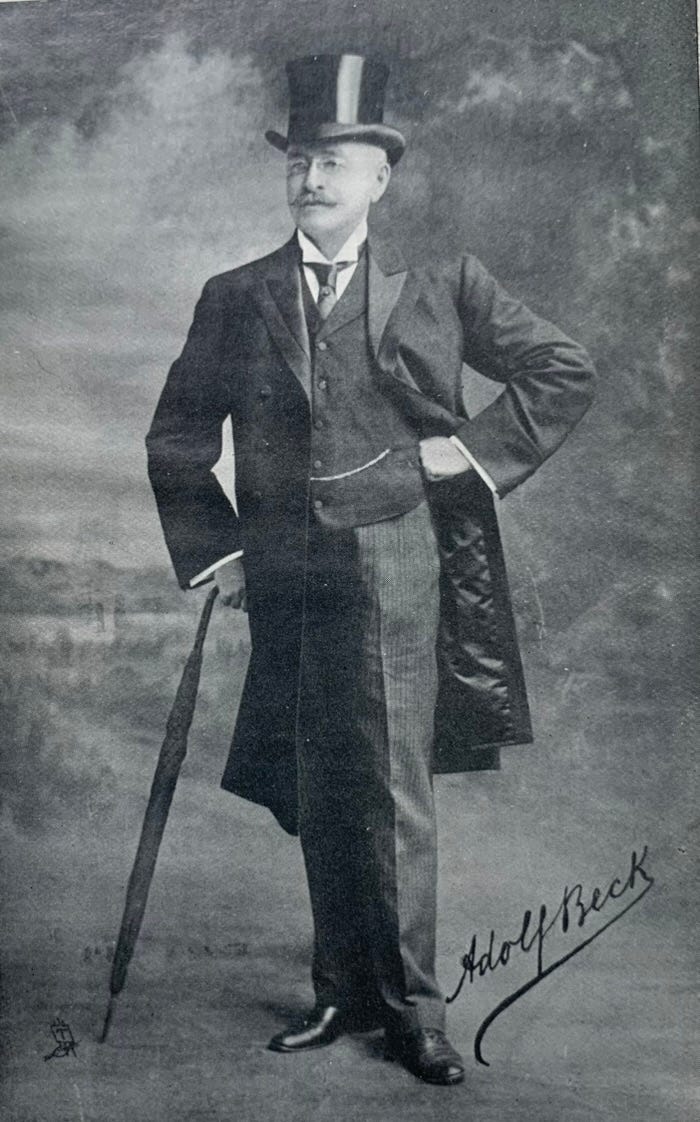
Miss Meissonier was not the first woman to have made a complaint to the Metropolitan Police in recent months about the activities of a fraudster. There had been a spate of such incidents.
“Oh pardon, are you Lady Everton?”
Later reports would describe the women involved as being of “loose character” or “prostitutes” (sex workers, as we might now call them) but I don’t think that is at all clear from the evidence, although it is notable how readily they all succumbed to the attentions of their defrauder.
Miss Meissonier described herself as a music teacher, living in Fulham. She had been walking down Victoria Street a month earlier when, as she believed, Mr Beck passed her, paused, turned back and raised his hat, asking, “Oh pardon, are you Lady Everton?”. No. He begged her forgiveness for the mistake and asked where she was going – to the flower show, she said. He replied that it was not worth seeing as the flowers were so poor, but he kept ten gardeners in Lincolnshire and his flowers were much better. She told him she had just received a box of chrysanthemums, and he asked to see them. She gave her address, asking if he was a foreigner. Oh, no, he said. English.
He called the next day as promised and was admitted by her servant, Mary Harvey. He was Lord Salisbury’s cousin, he said, he owned nearly all the property in West Brompton and lived on £180,000 a year in a house in St John’s Wood. He invited her to join him and six others on a trip to the Riviera.
Miss Meissonier initially declined but then thought not to throw away such an opportunity, so said she might manage a fortnight, but not longer. He wrote out a long list of things she would need, to be purchased at his expense, including a riding habit as his horses would be waiting when they landed. He gave her a cheque for £40. He offered to mend her watch glass and asked to take a small ring for size so he could get some rings made up for her. There was a second watch on the table and as soon as he left she missed it. She asked her servant to follow him but he had already vanished. The bank was not where he had said it would be and the cheque was no good. She went to Vine Street police station and reported the felony, giving a description of her deceiver, mentioning the mark below his right jaw.
Now, a fortnight later and there he was, bold as brass, on the steps of 139 Victoria Street. She’d know him anywhere. Beck later described what happened:
“What have you done with my watch?”
“Madam, I do not know you, you are mistaken”
“Oh no, I am not mistaken”.
According to Miss Meissonier he accused her of being a “common prostitute” who was in the habit of accosting men.
He told her he would have her arrested if she did not leave him alone. But she wouldn’t move so he said, come with me, and to the first constable he could find he said, “this woman is annoying me, making false accusations and I beg you to take her up”. But the officer said, “you must come too” and at the station it was her statement that was taken and within a few minutes two other woman had appeared and said, “yes, that is the man” and he was locked up.
An officer told him he answered the description of a man calling himself the Earl of Wilton who was wanted for stealing jewellery. “It is a great mistake”, said Beck.
By now, according to the police, there had been some 20 complaints of fraud and jewellery theft from different parts of the metropolis. A series of identification parades were arranged, with men rounded up from the street outside the station. Not every woman complainant was sure it was him, but plenty were. “I believe that is the man, if he takes off his hat, I shall know”, said Daisy Grant who had been sent for on the night of Beck’s arrest.
Back in July, Daisy Grant had been in St James, when a man approached her and asked if she remembered him. He was Wilton, he said. She gave him her address and he called the next day staying about 45 minutes, while he explained he was living in an empty house in St John’s Wood and perhaps she would like to go to it. She said she was happy where she was but he said he would like to buy her some dresses and jewellery, so he wrote out a cheque for £35 and asked for a ring to measure her finger and offered to fix the dented gold bracelet she was wearing. He said the items would be returned within the hour by a commissionaire with one arm in a sling. When he had gone she noticed a second ring was missing and when she could not find the bank to cash the cheque she went to the police.
The cases dated back to December of the previous year, when the recently bereaved Fanny Nutt, living near Regent’s Park had been in Bond Street, wearing widow’s weeds, when she was approached by Beck (as she now believed) who said, “you must be a very young widow”. She was only 21, she told him. After a brief conversation about her deceased husband, the man asked if he might visit her and she wrote out her address. He sent a note from the Grand Hotel, London to say he would call on her the next day, which he did.
From one woman he stole an ostrich feather fan and a pair of elephant tusks which he said he would have mounted as an ink stand.
Fanny thought he was quite the gentleman, with his monogrammed, silver topped umbrella. He said he had a nice house in St John’s Wood and invited her to be his housekeeper as the previous one was going away, albeit with £8000 in jewellery that he had gifted her. He had estates in Lincolnshire, he added, and would pay her £5 a week to start, rising to £10. He wanted her to get settled before he went on his yacht to the South of France. She would need new clothes. He made a list of dresses and jewellery, specifying the shops where she should go. He took two cheques from his pocket and gave her one for 15 guineas, which he put in an envelope, addressed to the Union Bank, Belgravia. He took two of her rings in an envelope, saying they would be returned shortly by a one-armed commissionaire. She later realised a brooch was missing.
All the stories the women told were the same or similar. He was the Earl of Wilton or sometimes Lord Willoughby, always of St John’s Wood and Lincolnshire, looking for a housekeeper or a companion. He wrote out lists of clothes and they gave him rings and other jewels for size or repair which he often said would be returned by a one-armed commissionaire. From one woman he stole an ostrich feather fan and a pair of elephant tusks which he said he would have mounted as an ink stand.
Some of the complainants read about the arrest of Mr Beck in the newspapers and went to the police station or the court and took part in further identification parades. As they picked him out, so the charges against Beck mounted, while those who had not picked him out were ignored.
Beck’s troubles deepened when it was recalled that the details of his alleged offences bore striking similarity to the evidence given at an Old Bailey trial in 1877 when a John Smith had been imprisoned for five years after being found guilty of defrauding two women in circumstances that were almost identical to the crimes Beck was believed to have committed, right down to the one armed commissionaire and the house in St John’s Wood.
A handwriting expert, Thomas Gurrin was asked to examine the notes written in both cases and asserted they had been written by the same person, who in some notes was deliberately trying to disguise their handwriting.
The arresting officer of Smith in 1877, Elias Spurrell, saw Beck and had no doubt they were the same man.
Yet more women came forward and picked Beck out from line ups in the police court yard. “I recognised him at once, as soon as I put my foot in the yard”, said Juliette Kluth, who was angry with the perpetrator. He had promised her diamonds and dresses and disappeared with her ring.
Beck was remanded at Holloway prison where he was stripped, so that his identifying marks could be recorded. There was some debate about whether there was a mark under his chin, like a scar, as some of the women had reported. Beck’s defence solicitor requested sight of John Smith’s identifying marks but they were not provided. Beck continued to deny he had ever met any of the women.
By the time his trial began there were ten complainants and numerous other prosecution witnesses who would testify to his identity as the thief. The trial judge, then the Common Serjeant, was Sir Frederick Fulton. The proceedings lasted for three days and when the defence tried to challenge Beck’s identity as John Smith, the trial proceeded without further reference to the 1877 case, so the only question was whether he was the perpetrator of the recent crimes. His evidence that he had been in South America, when the earlier crimes had been committed was thus neutralised.
Beck’s neck was examined by the jurors for a scar. Some in court said they could see a scar even though Beck insisted there was no scar. No trace had been found of any items in his possession that had been stolen from the complainants. Witnesses were called to say they had never seen him with any elephant tusks. Character witnesses spoke about his time in Peru: “The English thought a good deal of him”.
But it was all to no avail. Beck was convicted on multiple counts of obtaining jewellery and other items of value by false pretences and sentenced to seven years of “penal servitude”. He had been unable to give evidence on his own behalf as that was not then allowed in English trials. There was no criminal court of appeal. His only hope was to petition the Home Office for a pardon.
Beck went first to Wormwood Scrubs and then to Chelmsford and finally to Portland prison on the Isle of Wight. He was assigned the prison number DW523 but it was some months before he understood the significance: the W indicated that he had previously been convicted - as John Smith in 1877.
He sent his first petition that July. He would later explain its content: “I said I was absolutely innocent and a full statement of where I was in 1877. When I heard at Portland what DW meant I told the Governor that I had never been convicted before in my life.”
the doctor’s note was placed in Smith’s file where it remained, waiting for its importance to be appreciated.
His persistence in his claims of innocence, made Mr Beck a difficult prisoner. He was punished for talking and other trivial things, several times, he said. He came to believe there was a conspiracy against him. He was falsely accused of misdemeanours and was punished with eight days’ ration of bread and water. The prison doctor warned they would kill him if they carried on, so he was returned to a full diet. He worked in the tailor’s shop - and also in stone breaking. He never gave up protesting and, during his sentence sent no less than 12 petitions to the Home Office.
Were Beck and Smith the same man?
In 1879, two years after his first conviction, John Smith, who had also, but earlier, been incarcerated at Portland, applied to the governor to be entered on the records as a Jew. He had a special medical examination and the prison doctor confirmed that he had been circumcised. Although that information was not included on his record of marks, the doctor’s note was placed in Smith’s file where it remained, waiting for its importance to be appreciated.
This is notes on crime 08 thank you for reading. Please subscribe, please share the article and please feel free to leave a comment. Many thanks, David.
Sources: Notable British Trials: Trial of Adolf Beck edited by ER Watson, Wm Hodge and Co, 1924; The Strange Story of Adolf Beck by Tim Coats, Argonaut Papers, 2019; articles from The Times Digital Archive.
Next week: The Amazing Mr Beck. Part Two - Up To His Old Tricks